
Clinical neuroscience into care
What is interventional psychiatry?
Interventional psychiatry brings neuroscience and technology into procedural treatments for mental health conditions.
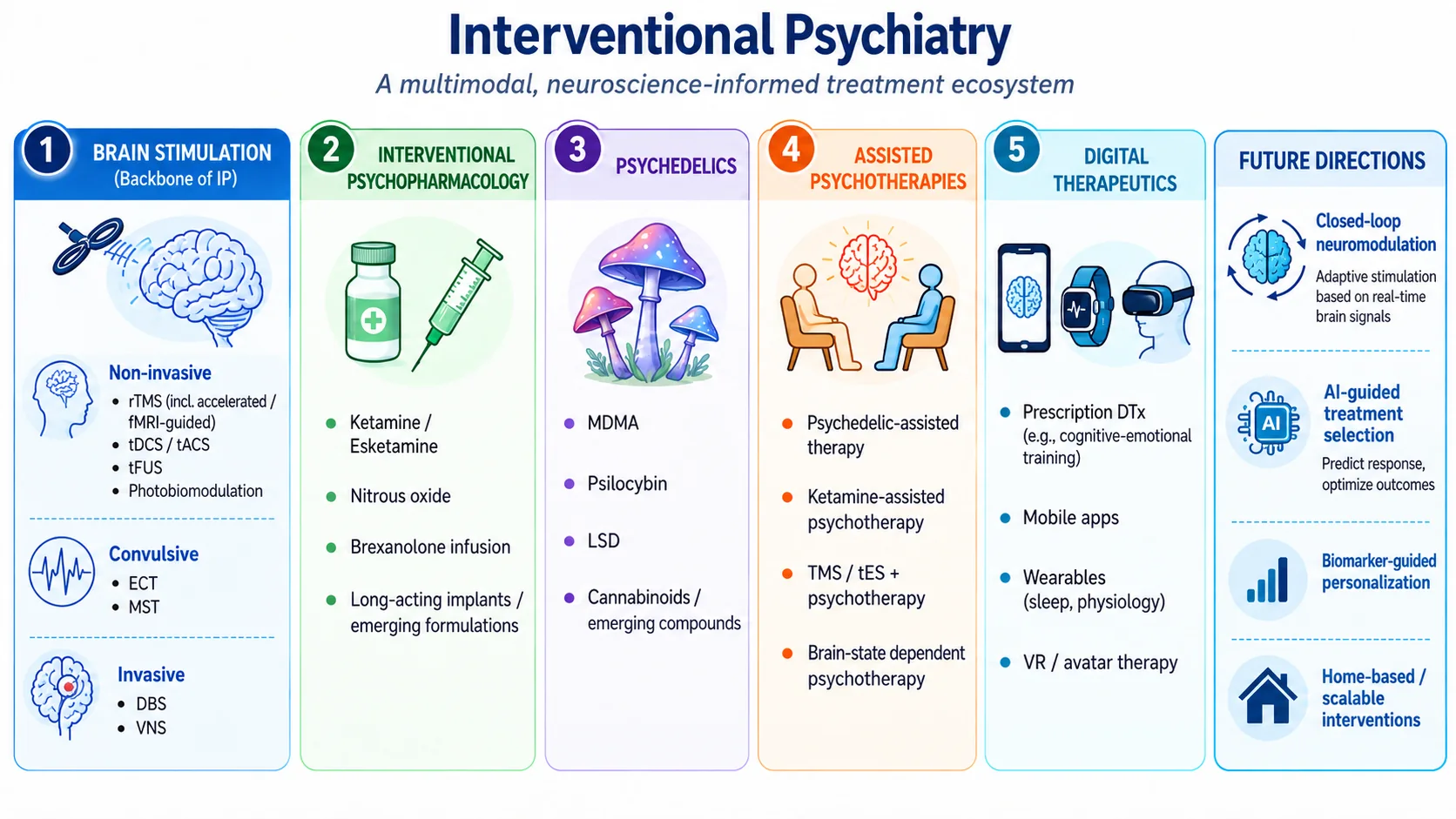
In our viewpoint paper, Dr. Samir Kumar Praharaj and I describe a broad field that connects brain stimulation with specialist medication interventions, psychedelics, assisted psychotherapies, and digital therapeutics. Its development depends on sound evidence, structured training, and careful clinical delivery.
Why this field matters
Some people continue to experience substantial symptoms despite conventional treatments, or find their adverse effects difficult to tolerate. Interventional psychiatry expands the treatment options clinicians can consider within comprehensive care. Our paper connects this clinical need with the wider challenge of improving access to mental healthcare in India.
Five connected areas
Brain stimulation
These approaches use physical stimulation to influence brain activity. The paper distinguishes nonconvulsive techniques, seizure-based treatments, and implanted stimulation.
- TMS and electrical stimulation: repetitive transcranial magnetic stimulation (rTMS) and transcranial electrical stimulation, including tDCS, tACS, and tRNS. Accelerated and individually targeted TMS are important directions discussed in the paper.
- Seizure-based treatments: electroconvulsive therapy (ECT), delivered under anaesthesia, and magnetic seizure therapy (MST), discussed as an emerging approach.
- Implanted and emerging methods: deep brain stimulation, vagus nerve stimulation, focused ultrasound, and photobiomodulation. Their applications and evidence differ substantially.
Interventional psychopharmacology
Some medication treatments require a procedure, dedicated monitoring, or specialist infrastructure. Our paper discusses ketamine and esketamine, alongside examples such as nitrous oxide and neurosteroid infusions. The emphasis is on how these treatments are selected, delivered, and monitored—not simply on whether a medicine is new.
Psychedelics as therapeutics
The paper explores the therapeutic research surrounding substances such as psilocybin and MDMA. This is an area where promising findings must be considered alongside uncertainty, psychological support needs, monitoring, and the applicable regulatory framework. Inclusion in this overview does not imply routine clinical availability.
Assisted psychotherapies
Psychological treatment can be combined with a medication intervention or brain stimulation, either together or in sequence. The paper considers ketamine- and psychedelic-assisted psychotherapy, as well as combinations of psychotherapy with TMS or electrical stimulation. The purpose is to study how these approaches might complement one another.
Digital therapeutics
The broader framework includes structured digital interventions, virtual reality, and technology-assisted therapies. It also discusses wearable monitoring and AI as ways to support assessment, track outcomes, and investigate treatment prediction. These technologies require evidence and appropriate clinical oversight.
Training, access, and responsible innovation
A central argument of our paper is that new interventions require more than new equipment. Clinicians need supervised training, clear competencies, standardized protocols, and the ability to evaluate both benefits and adverse effects. In India, strengthening training and connecting research with clinical services are key priorities.
The future directions we discuss include personalized and closed-loop neuromodulation, better integration of treatments, and digital approaches that support care. Their value depends on rigorous research and meaningful outcomes for patients.
The paper behind this page
Interventional Psychiatry in India: Bridging Treatment Gaps and Expanding Horizons in Mental Health
Joseph JT and Praharaj SK. Indian Journal of Psychological Medicine. 2024. Viewpoint.
Read our paperDOI: 10.1177/02537176241294146